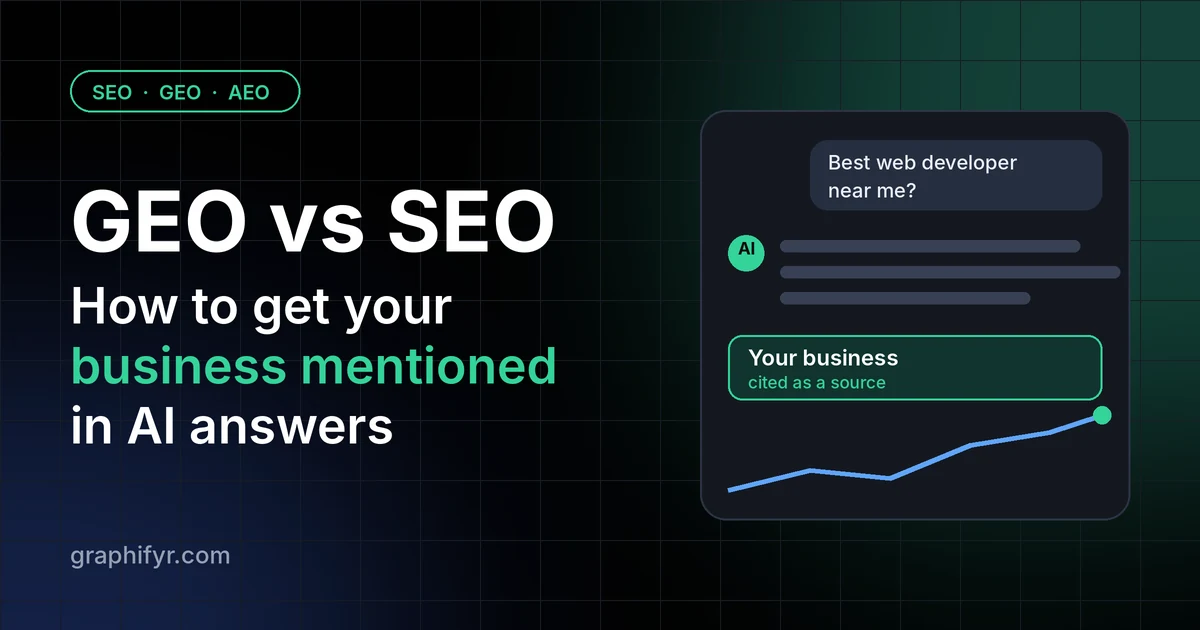
A growing number of customers no longer start with a list of blue links. They ask ChatGPT, Gemini or Perplexity a question — or read the AI summary at the top of Google — and take the first few names they see. If your business is not one of those names, a visitor may never reach your website at all.
That is the idea behind two newer terms you will hear from marketers: AEO and GEO. This post explains what they mean in plain language, how they differ from ordinary SEO, and seven practical steps a small business can take. We will also be upfront about what nobody can promise.
What do GEO and AEO actually mean?
SEO (search engine optimisation) helps your pages rank in search results. AEO (answer engine optimisation) is about writing so that a search or voice tool can lift a short, direct answer from your page. GEO (generative engine optimisation) is about being cited or mentioned inside answers that AI tools write on the fly.
The labels are new, but the work is familiar: be clear, be accurate, be easy to find, and be trusted by others. If you already invest in SEO, you are most of the way there.
How is this different from classic SEO?
| Classic SEO | GEO / AEO | |
|---|---|---|
| Goal | Rank a page and earn the click | Be quoted, named or linked inside the answer |
| Unit of success | Position in a results list | A mention or citation, which varies by question |
| What helps most | Relevance, page quality, links, speed | Clear answers, specific facts, consistent details, third-party mentions |
| How predictable | Fairly stable day to day | Answers can change from one day to the next |
The practical takeaway: GEO and AEO do not replace SEO. They sit on top of it. A site that Google cannot crawl or understand is unlikely to be used by AI tools either.
1. Answer the question in the first few lines
AI tools and search features favour pages that state the answer plainly. If someone asks “how much does a basic business website cost?”, a page that opens with a clear range and what affects it is easier to quote than one that starts with three paragraphs about your company history.
How to check: pick one service page, read only its first two lines, and ask whether a stranger would learn something useful.
How to fix: use headings written as real customer questions, put a one- or two-sentence answer directly under each, then add the detail below it.
2. Make sure crawlers can actually reach your pages
If a page is blocked or cannot be indexed, it cannot be shown in search or used in AI answers. Common causes are a leftover “noindex” tag from the development stage, a robots.txt file that blocks everything, or important text that only appears after heavy JavaScript runs.
How to check: open yourwebsite.com/robots.txt, search site:yourwebsite.com on Google, and use Google Search Console to see which pages are indexed.
How to fix: remove accidental blocks, submit a sitemap, and keep your key content in plain HTML text. Remember that robots.txt also lets you decide which AI crawlers you welcome, so make that choice on purpose rather than by accident.
3. Be specific instead of generic
“We offer affordable, quality solutions” gives an AI tool nothing to quote. Specific facts do: what you sell, who it is for, typical price ranges, how long it takes, the areas you serve and what is included.
How to check: highlight every sentence on your service page that a competitor could copy word for word. Those are the weak ones.
How to fix: replace vague claims with numbers, steps, locations and examples from real projects.
4. Add structured data and FAQs that match the page
Structured data (schema markup) tells machines what a page is about — your business, your services, an article, a list of questions. It does not guarantee a mention, and Google no longer shows FAQ rich results for most sites, but it removes guesswork and keeps your information consistent. The one rule: the markup must match what visitors can actually see on the page.
How to check: run a page through Google's Rich Results Test and look for errors or missing fields.
How to fix: add Organization and LocalBusiness details site-wide, Article markup on blog posts, and a short visible FAQ section on service pages with matching markup.
5. Keep your business details identical everywhere
AI tools cross-check what different sources say about you. If your name, address, phone number or services differ between your website, Google Business Profile, social pages and directories, it is harder for any system to be confident about who you are.
How to check: search your business name and compare the first ten results line by line.
How to fix: choose one official version of your name, address, phone number and service description, then update every listing to match. Keep your Google Business Profile complete and current.
6. Earn mentions and reviews on trusted sites
AI answers often reflect what other sites say about a business, not only what the business says about itself. Genuine reviews, local directories, industry listings, news coverage and helpful answers on public forums all add to the picture.
How to check: search for your business name plus the words “reviews” and “near me”, and see what appears beyond your own site.
How to fix: ask happy customers for honest reviews, list the business in respected local and industry directories, and share useful knowledge where your customers already ask questions. Avoid fake reviews and paid link schemes — they backfire.
7. Show real people and real expertise
Pages that show who wrote them, who runs the business and what work has actually been done are easier to trust, for people and for machines. This matches the quality signals Google describes as experience, expertise, authoritativeness and trustworthiness.
How to check: could a stranger find out who is behind your business and see proof of past work in under a minute?
How to fix: add an About page with real names and photos, author lines and dates on articles, short case studies with results, and a clear way to contact you. Update older posts when facts change.
Myths to ignore
- “Guaranteed ChatGPT ranking.” Nobody controls AI answers, and they differ between tools and even between two askings of the same question.
- “You need a special file or a secret trick.” An llms.txt file is optional and not proven to matter. Spend that time on content and trust instead.
- “SEO is dead.” AI tools still lean on the open web, so the fundamentals still matter.
- “Stuff your page with keywords for AI.” Clear, helpful writing beats repetition every time.
How to see whether AI tools mention you
There is no official ranking report yet, so a simple manual check is the best starting point. Once a month, ask ChatGPT, Gemini, Perplexity and Google the questions your customers would ask — usually your service plus your city. Record whether your business is named, whether your website is linked, and whether the details are correct. Treat it as a trend over time, not a daily score.
- Write down the five questions customers ask most often.
- Confirm your key pages are indexed and not blocked by robots.txt or noindex.
- Check that each service page answers its main question in the first two lines.
- Make your name, address and phone number identical on every listing.
- Add a short visible FAQ and matching schema to your top service page.
- Ask two recent customers for an honest review.
- Ask three AI tools your main question and note what they say.
Frequently asked questions
What is the difference between SEO, GEO and AEO?
SEO is about ranking your pages in search results. AEO (answer engine optimisation) is about writing so that a search or voice tool can lift a clear, direct answer from your page. GEO (generative engine optimisation) is about being cited or mentioned inside answers written by AI tools such as ChatGPT, Gemini, Perplexity and Google's AI features. In practice the three overlap heavily, and good SEO is the foundation for the other two.
Can anyone guarantee that my business will appear in ChatGPT or Google AI answers?
No. AI answers are generated differently each time and the providers do not publish a ranking formula. Anyone who promises a guaranteed mention is overstating what is possible. What you can do is make your site easy to crawl, clear to understand and well supported by trustworthy third-party mentions, which raises your chances.
Do I need special schema or a file like llms.txt?
You do not need anything special to be eligible for Google's AI features beyond being indexed and eligible to show in search. Structured data helps machines understand your content and is worth adding where it matches what is visible on the page. An llms.txt file is optional, and there is no solid evidence yet that major AI search tools rely on it, so do not treat it as a shortcut.
How do I check whether AI tools mention my business?
Ask ChatGPT, Gemini, Perplexity and Google the questions your customers would ask, for example the service plus your city. Note whether your business is named, whether your website is linked, and what the answer says about you. Repeat monthly and keep a simple log, because answers vary from one day to the next.
If you would like help, our SEO / GEO / AEO service covers the technical checks, content and listings described above. You can also try our free SEO tools, or get in touch and share your website address for a quick review.